

Welcome! Read More →
Independence Day, commonly known as the Fourth of July, is a federal holiday in the United States commemorating the adoption of the Declaration of Independence on July 4, 1776, declaring independence from the Kingdom of Great Britain. Independence Day is commonly associated with fireworks, parades, barbecues, carnivals, fairs, picnics, concerts, baseball games, family reunions, and political speeches and ceremonies, in addition to various other public and private events celebrating the history, government, and traditions of the United States. Independence Day is the National Day of the United States.[1][2][3]
Background
During the American Revolution, the legal separation of the Thirteen Colonies from Great Britain occurred on July 2, 1776, when the Second Continental Congress voted to approve a resolution of independence that had been proposed in June by Richard Henry Lee of Virginia declaring the United States independent from Great Britain.[4][5] After voting for independence, Congress turned its attention to the Declaration of Independence, a statement explaining this decision, which had been prepared by a Committee of Five, with Thomas Jefferson as its principal author. Congress debated and revised the wording of the Declaration, finally approving it on July 4. A day earlier, John Adams had written to his wife Abigail:
The second day of July, 1776, will be the most memorable epoch in the history of America. I am apt to believe that it will be celebrated by succeeding generations as the great anniversary festival. It ought to be commemorated as the day of deliverance, by solemn acts of devotion to God Almighty. It ought to be solemnized with pomp and parade, with shows, games, sports, guns, bells, bonfires, and illuminations, from one end of this continent to the other, from this time forward forever more.[6]read more »
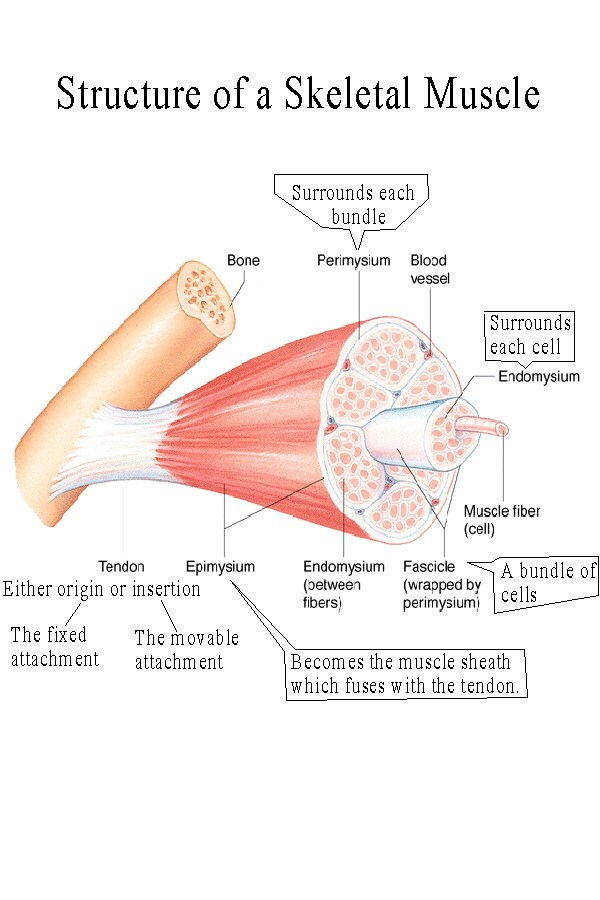
The human body is comprised of hundreds of muscles, about 640 in total. There is no exact count largely because expert opinions are conflicted regarding what constitutes a distinct muscle. Therefore, some experts will suggest 639 total while others may suggest there are more. Muscles are found within the muscular system, which is the body’s own network of tissues and fibers responsible for both outward and inward movements of the body.
While the exact number in the human body may not be known, what is known is that muscles are categorized as one of three different types: striated, smooth, and cardiac.

Breathing as a bridge:
It is thought by many cultures that the process of breathing is the essence of being. A rhythmic process of expansion and contraction, breathing is one example of the consistent polarity we see in nature such as night and day, wake and sleep, seasonal growth and decay and ultimately life and death. In yoga, the breath is known as prana or a universal energy that can be used to find a balance between the body-mind, the conscious/unconscious, and the sympathetic-parasympathetic nervous system. Unlike other bodily functions, the breath is easily used to communicate between these systems, which gives us anexcellent tool to help facilitate positive change. It is the only bodily function that we do both voluntarily and involuntarily. We can consciously use breathing to influence the involuntary (sympathetic nervous system) that regulates blood pressure, heart rate, circulation, digestion and many other bodily functions. Pranayama is a yoga practice that literally means the control of life or energy. It uses breathing techniques to change subtle energies within the body for health and well being. Breathing exercises can act as a bridge into those functions of the body of which we generally do not have conscious control.
An Example of how life effects physiology:
During times of emotional stress our sympathetic nervous system is stimulated and effects a number of physical responses. Our heart rate rises, we perspire, our muscles tense and our breathing becomes rapid and shallow. If this process happens over a long period of time, the sympathetic nervous system becomes over stimulated leading to an imbalance that can effect our physical health resulting in inflammation, high blood pressure and muscle pain to name a few. Consciously slowing our heart rate, decreasing perspiration and relaxing muscles is more difficult than simply slowing and deepening breathing. The breath can be used to directly influence these stressful changes causing a direct stimulation of the parasympathetic nervous system resulting in relaxation and a reversal of the changes seen with the stimulation of the sympathetic nervous system. We can see how our bodies know to do this naturally when we take a deep breath or sigh when a stress is relieved.
The breathing process can be trained: Breathing can be trained for both positive and negative influences on health. Chronic stress can lead to a restriction of the connective and muscular tissue in the chest resulting in a decrease range of motion of the chest wall. Due to rapid more shallow breathing, the chest does not expand as much as it would with slower deeper breaths and much of the air exchange occurs at the top of the lung tissue towards the head. This results in “chest” breathing. You can see if you are a chest breather by placing your right hand on your chest and your left hand on your abdomen. As you breathe, see which hand rises more. If your right hand rises more, you are a chest breather. If your left hand rises more, you are an abdomen breather.
Chest breathing is inefficient because the greatest amount of blood flow occurs in the lower lobes of the lungs, areas that have limited air expansion in chest breathers. Rapid, shallow, chest breathing results in less oxygen transfer to the blood and subsequent poor delivery of nutrients to the tissues. The good news is that similar to learning to play an instrument or riding a bike, you can train the body to improve its breathing technique. With regular practice you will breathe from the abdomen most of the time, even while asleep.

Body mechanics is a term used to describe the ways we move as we go about our daily lives. It includes how we hold our bodies when we sit, stand, lift, carry, bend, and sleep. Poor body mechanics are often the cause of back problems. When we don’t move correctly and safely, the spine is subjected to abnormal stresses that over time can lead to degeneration of spinal structures like discs and joints, injury, and unnecessary wear and tear.

Overview:
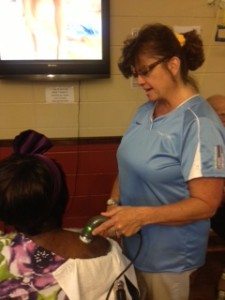
Physical therapists use a variety of modalities to help treat their patients. There are a variety of treatment modalities that can help strengthen, relax, and heal muscles. Below are a few of the treatment modalities physical therapists used daily in their practice.
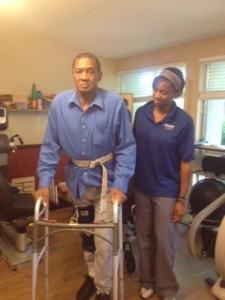
Mr. William Porter practices his walking with Pam Mincy, PTA, and Rita Jackson, COTA, in preparation of a safe return home.
Rotator Cuff Tears
A rotator cuff tear is a common cause of pain and disability among adults. In 2008, close to 2 million people in the United States went to their doctors because of a rotator cuff problem.
A torn rotator cuff will weaken your shoulder. This means that many daily activities, like combing your hair or getting dressed, may become painful and difficult to do.
Anatomy

Normal anatomy of the shoulder
Your shoulder is made up of three bones: your upper arm bone (humerus), your shoulder blade (scapula), and your collarbone (clavicle). The shoulder is a ball-and-socket joint: The ball, or head, of your upper arm bone fits into a shallow socket in your shoulder blade.
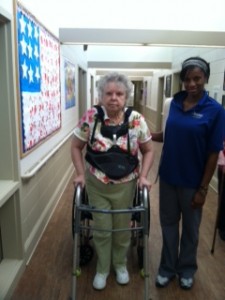
We want to say, “Great job!“ to Ms. Johnson who has worked so hard to be walking and standing tall! Keep up the good work!